Foundation repair cost in Edmond, Oklahoma: 2026 numbers
Most Oklahoma foundation jobs land between $3,000 and $9,000. The ones that cost more are nearly always pier jobs, and the pier count is what sets the price — which is why nobody can give you a figure over the telephone.
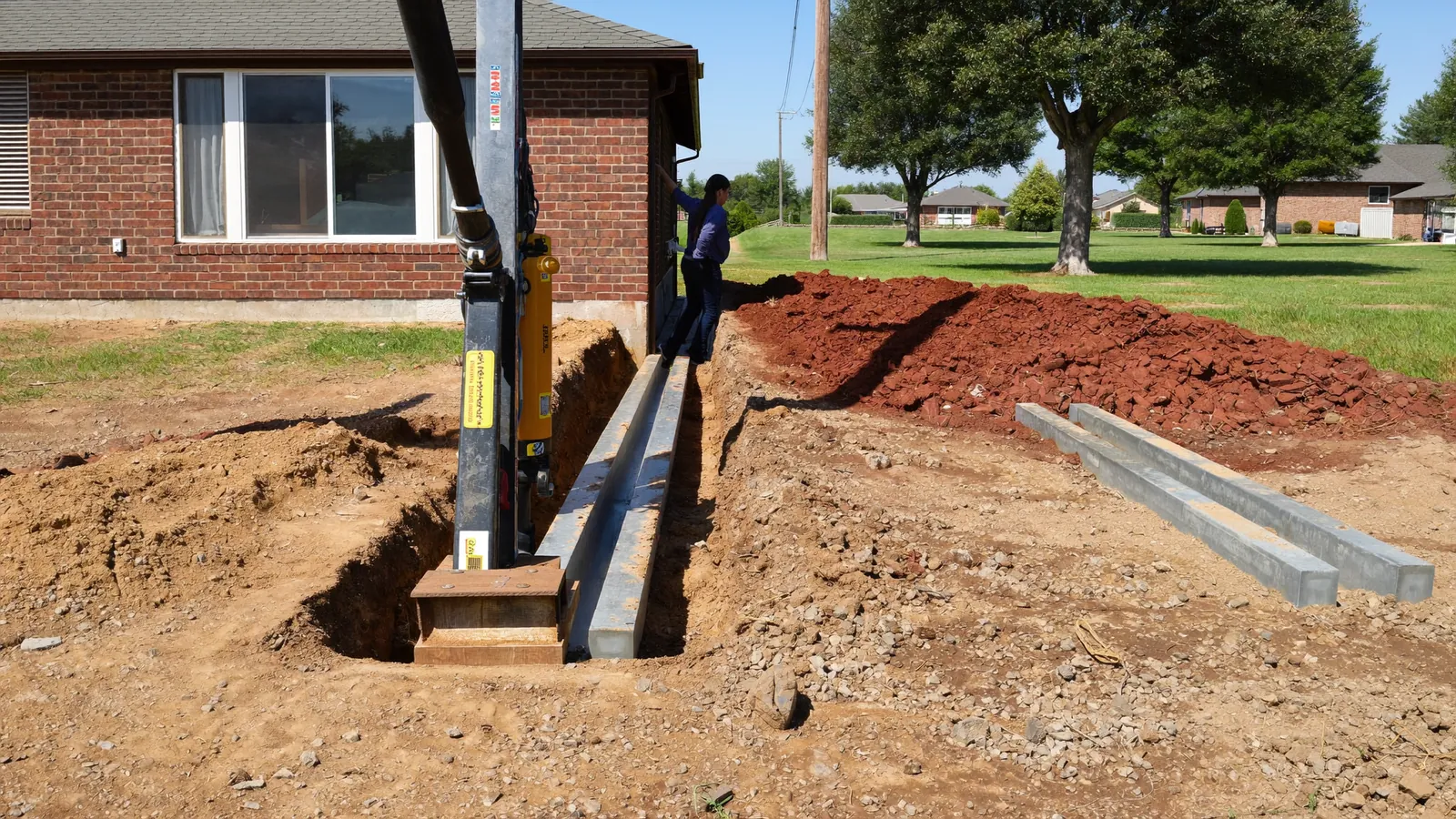
Let us start with the honest framing. Every number on this page is a budgeting band drawn from published cost guides and from what this type of work runs in the Oklahoma City metro. None of it is a quotation. The figure for your house comes after a floor elevation survey, because the price is driven by how many piers are needed and where they go, and that comes from the shape of the movement rather than from the length of a crack.
The price list
| Work | 2026 range | What moves it |
|---|---|---|
| Inspection and floor elevation survey | Free – $350 | Free on most local homes |
| Independent engineer's report | $350 – $900 | Their fee, not ours |
| Crack injection, epoxy or polyurethane | $250 – $1,200 | Per crack; ~$550 typical |
| Steel push pier, installed | $1,200 – $2,800 | Each; depth and access |
| Helical pier, installed | $1,500 – $3,200 | Each; torque specification |
| Interior pier through slab | Add $300 – $700 | Per pier; cutting and restoration |
| Typical whole-house pier job | $8,000 – $18,000 | 2,000 sq ft, 6–12 piers |
| Pier and beam releveling | $2,500 – $12,000 | ~$5,200 average |
| Mudjacking / slab lifting, per section | $500 – $1,500 | ~$2,800 per project |
| Crawl space repair | $2,000 – $9,500 | ~$4,000 average |
| Crawl space encapsulation with structural work | $5,000 – $12,000 | Liner, sealing, conditioning |
| French drain, per linear foot | $25 – $75 | Depth and access |
| Complete drainage package | $1,500 – $6,000 | Often the best first spend |
| Full slab replacement | $8,000 – $20,000 | Rare; ~$12,000 typical |
| City permit | $100 – $500 | By jurisdiction and scope |
Where Oklahoma sits nationally
Published regional guides put Oklahoma, Kansas and Missouri in the $3,000 to $9,000 band for typical foundation repair, against a national range of roughly $2,000 to $15,000 and above. Minor work — sealing a few cracks, small patching — sits at $500 to $3,000. Moderate work, meaning limited piering or partial stabilization, runs $3,000 to $10,000. Major work, full perimeter piering or whole-house leveling, starts around $10,000 and goes up with the size and complexity of the house.
What actually drives your number
The pier count. This is the dominant variable by a wide margin. A house needing four piers along one elevation is a completely different proposition from one needing twelve around most of the perimeter, and at $1,200 to $3,200 apiece the difference is tens of thousands. The count comes from the floor contour and the load path, not from the size of the house.
Interior versus exterior work. Exterior piers are dug from outside. Interior piers mean saw-cutting the floor, working inside, then restoring concrete and finishes — add $300 to $700 per pier, plus the disruption.
Access. A pier location reachable with a machine costs less than one hand-dug between a wall and a boundary fence. Mature landscaping, hard standing, decking and tight side returns all add labor.
Foundation type. Pier-and-beam repair is generally far cheaper than slab repair for the same symptom, because the structure is accessible and nothing has to be cut or driven to depth. If you have an older house with a crawl space, that is genuinely good news.
Depth to bearing. Piers are driven or torqued until they meet criteria, not to a set depth. Where competent material is deeper, each pier takes more sections and more time.
What else is in the scope. Drainage correction, concrete leveling of drives and walks, crack repair and cosmetic reinstatement are all separate items, and a scope that includes them will look larger than one that does not — sometimes because it is more thorough rather than more expensive.
The cheap work that sometimes replaces the expensive work
This is the part worth reading twice. On a house with modest symptoms where the exterior walk finds a clear water fault — downspouts discharging at the wall, ground falling back toward the house, irrigation soaking one side of the perimeter — correcting the water and monitoring through a seasonal cycle is frequently the proportionate step. Downspout extensions cost $150 to $500 each. Regrading at the foundation is $600 to $2,500. A full drainage package is $1,500 to $6,000. Against an $8,000 to $18,000 pier job, that is a different order of spending, and a meaningful number of Edmond houses stabilize once the water is managed. It will not fix a foundation that has genuinely lost bearing support — but establishing which situation you are in is exactly what the survey is for.
Common questions
Why can't you quote over the phone?
Because the pier count sets the price, and the pier count comes from measuring the floor. Two houses on the same street with identical-looking cracks can need four piers and twelve respectively, a difference of perhaps $20,000. A figure given before a survey is a guess, and in this trade guesses are reliably high because the person guessing does not want to go back and ask for more. The survey takes an hour or two and is usually free.
Is the cheapest quote ever the right one?
Sometimes, and it is worth knowing how to tell. Compare scopes rather than totals: how many piers, at which locations, by which method, driven to what criteria, with what included for restoration, and what the warranty actually says. A lower number often means fewer piers or a narrower scope rather than better value, and occasionally it means a company that will find extras once the ground is open. A higher number is not automatically more thorough either. The itemized comparison is the only way to see it.
Do I pay for the inspection if I don't go ahead?
No, on most residential properties in our area — the elevation survey and the written report are free whether or not there is work to do, and a meaningful share of our inspections end with us saying nothing needs doing. We charge where the visit is substantially longer than standard: large or unusual properties, pre-purchase reports at short notice, and commercial buildings. You are told any fee when you book.
Can I do the work in stages?
Often yes, and sometimes it is the right call. Where movement is concentrated in one area, stabilizing that elevation now and monitoring the rest is reasonable. Drainage correction first, then structural work later if monitoring shows it is needed, is a sensible sequence on a house with modest symptoms. What we would not recommend is splitting a single structural scope across years in a way that leaves part of a wall supported and part not — we will tell you which parts can wait and which cannot.
Does foundation work add value to the house?
It protects value more than it adds it. Buyers and their inspectors look for foundation issues in this market, and visible cracking with no documentation is a reliable price-reducer. A completed repair with elevation readings, permit paperwork and a transferable warranty turns an open-ended worry into a closed file, which is worth real money at the negotiating table — but nobody pays a premium for a repaired foundation over one that never needed repair.
How firm is the written scope?
Firm for the work described, for the period stated on it, normally 30 days. The circumstance that changes it is genuinely unforeseen ground conditions — buried obstructions, fill nobody knew about, a pier location that cannot be reached as planned. If that happens, work stops and you get a revised figure to approve before anything proceeds. You should never receive an invoice larger than the scope without having agreed to it first.
Related: Pier cost in detail · How the clay works · Book an inspection · Paying for the work